
简介:
村上春树Synth81Z v1.0.2包括补丁和Keygen-R2R
团队R2R | 2026年10月5日 | 9.5MB
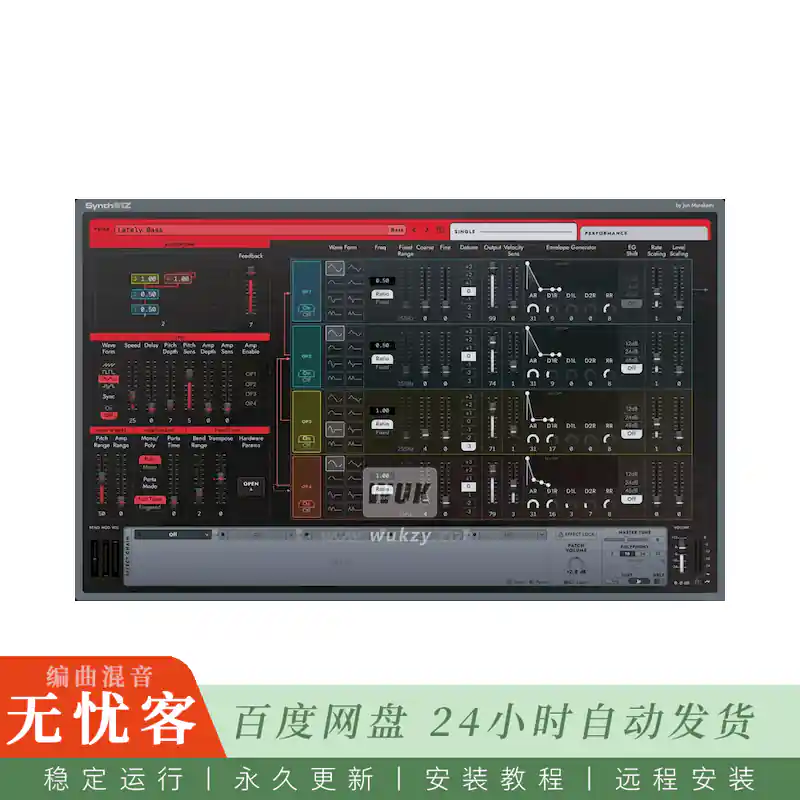
最新的,也是最胖的,最近的低音。一个紧凑的四运营商调频合成器。
雅马哈TX81Z于1987年发布,是1U机架中的四运营商FM音调发生器。被认为是一种经济实惠的方式,可以将由六个运营商DX7开创的FM合成带给更多的音乐家,这个小型单元仍然具有甚至更大的兄弟姐妹所缺乏的功能: 早期的FM合成器仅提供正弦波,TX81Z的每个运营商都可以从八种波形中进行选择。结合其独特的模拟电路的特征,这使它具有与dx7完全不同的吸引人的声音。
最重要的是,预设的 “最近低音” 是将TX81Z写入音乐史的声音。凭借其扭曲的谐波,锋利的攻击和顽强的低端,它从19 80年代后期到19 90年代的无数热门歌曲,尤其是舞蹈音乐。
它从来都不是一个简单的机器,从它的前面板编程,但其实惠的价格和标志性的声音使它在无数音乐家的录音棚中占有一席之地,包括,这个插件的开发者。
最新TX81Z声音,由硬件测量精制而成
TX81Z的声音集中在单个FM芯片YM2414 (更好地称为OPZ) 及其输出级中。作为数字合成器,雅马哈的FM芯片已经被记录和模拟了很多次。但是,一旦我把TX81Z作为一个单一的工具,很明显,这些实现远远不够。因此,与Synth-80一样,Synth81Z的开发始于对硬件的详尽测量。
最后,它与硬件进行了详细的匹配: 运算符的相位分辨率和波形表的舍入,八个波形中的每一个的精细细节,随算法变化的输出电平,每个包络步骤的定时,对LFO的响应,速度和控制器,以及从DAC到输出级的频率响应。所有的东西,包括 “最近的低音”,然后被ear推到极限,反对真实单位的录音。
多达32种声音的复音
选择8、16、24或32种声音。八个与硬件匹配; 较高的设置相当于堆叠多个芯片的软件。
八部分性能模式
硬件兼容的图层,拆分和多音色设置,以及连续平移的模式和每个部分的独立LFO,使其作为软件使用变得舒适。
五插槽效果机架
从Synth-80继承的十二种高质量效果: 四个合唱 (合成器,录音室,音高和数字),延迟,相位器,镶边器,EQ,压缩器,失真,混响和Arpeggiator。
编辑和图书管理员
通过MIDI连接一个真正的TX81Z,您在插件中的编辑将被镜像到硬件。SysEx发送/接收声音,表演和桌子,。syx/.mid导入和bank builder让您继续使用硬件语音库。
MIDI学习和DAW自动化也支持。这些添加的内容都不会改变硬件声音: 将复调设置为8,并且您具有单个芯片的行为,与原始芯片完全一样。
简介:
Jun Murakami Synth81Z v1.0.2 Incl Patched and Keygen-R2R
Team R2R | 05 Oct 2026 | 9.5MB
The newest, and the fattest, Lately Bass. A compact four-operator FM synthesizer.
Released in 1987, the Yamaha TX81Z is a four-operator FM tone generator in a 1U rack. Conceived as an affordable way to bring the FM synthesis pioneered by the six-operator DX7 to more musicians, this small unit nevertheless holds features that even its bigger siblings lacked: where earlier FM synths offered only sine waves, each of the TX81Z’s operators can choose from eight waveforms. Combined with the character of its distinctive analog circuitry, this gives it an appealing sound quite unlike the DX7.
Above all, the preset “Lately Bass” is the sound that wrote the TX81Z into music history. With its distorted harmonics, razor-sharp attack and tenacious low end, it anchored countless hits from the late 1980s through the 1990s, above all in dance music.
It was never an easy machine to program from its front panel, but its affordable price and iconic sounds earned it a place in the studio racks of countless musicians, including, back in the day, the developer of this plugin.
The latest TX81Z sound, refined by hardware measurement
The TX81Z’s sound is concentrated in a single FM chip, the YM2414 (better known as the OPZ), and its output stage. Being digital synths, Yamaha’s FM chips have been documented and emulated many times before. But once I focused on the TX81Z as a single instrument, it became clear that those implementations fell far short. And so, as with Synth-80, the development of Synth81Z began with exhaustive measurement of the hardware.
In the end, it matches the hardware in detail: the phase resolution of the operators and the rounding of the waveform tables, the fine detail of each of the eight waveforms, output levels that change with the algorithm, the timing of every envelope step, the response to the LFO, velocity and controllers, and the frequency response from the DAC through the output stage. Everything, “Lately Bass” included, was then pushed to the limit by ear against recordings of the real unit.
Up to 32 voices of polyphony
Choose 8, 16, 24 or 32 voices. Eight matches the hardware; the higher settings are the software equivalent of stacking several chips.
Eight-part Performance mode
Hardware-compatible layers, splits and multitimbral setups, plus a mode with continuous pan and an independent LFO for every part, making it comfortable to use as software.
Five-slot effects rack
Twelve high-quality effects inherited from Synth-80: four choruses (Synth, Studio, Pitch and Digital), Delay, Phaser, Flanger, EQ, Compressor, Distortion, Reverb and Arpeggiator.
Editor and librarian
Connect a real TX81Z over MIDI and your edits in the plugin are mirrored to the hardware. SysEx send/receive for voices, Performances and tables, .syx/.mid import and a bank builder let you keep using your hardware voice library.
MIDI Learn and DAW automation are supported as well. None of these additions alters the hardware sound: set the polyphony back to 8 and you have the behaviour of a single chip, exactly like the original.


评论0