
简介:
村上春树Synth-80 v1.0.23包括修补和Keygen-R2R
团队R2R | 2026年10月5日 | 11.0MB
世界上唯一的,最好的,木星忠实地再现了传说中的MKS-80。
罗兰MKS-80超级木星是一个传奇的合成器,仅在1984年开始的短时间内生产。这款8音复音模拟合成器通常被JUPITER-8等流行键盘所掩盖,不仅由其精致的声音定义,而且还具有显着的特征: 几乎每个参数都可以通过MIDI控制。
对于其时代的完全模拟合成器来说,这是非常罕见的,它使MKS-80成为软件合成器研究的理想主题-换句话说,很容易构建测量程序,一次又一次地重新触发笔记,同时自动扫描参数,捕获详细的分析。在这个项目中,我编写了100多个专用的自动测量程序,涵盖了MKS-80的每个电路和参数。
这个长期的,详细的MKS-80分析 (Rev.4) 是与软件编程本身并行进行的,我将音频DSP调谐推到了极限,依靠耳朵我已经培养了多年的作曲家和音乐制作人。因此,当您在两者上加载完全相同的补丁并并排播放时,对于许多补丁来说,几乎不可能分辨哪个是软件,哪个是硬件。
从滤波器的微妙特性到来自IC芯片的细微差别的噪声振荡器,声音纹理,对每一个细节都有细致的关注,将硬件仿真的级别提升到一个新的高度。
一个简单的,精简的用户界面
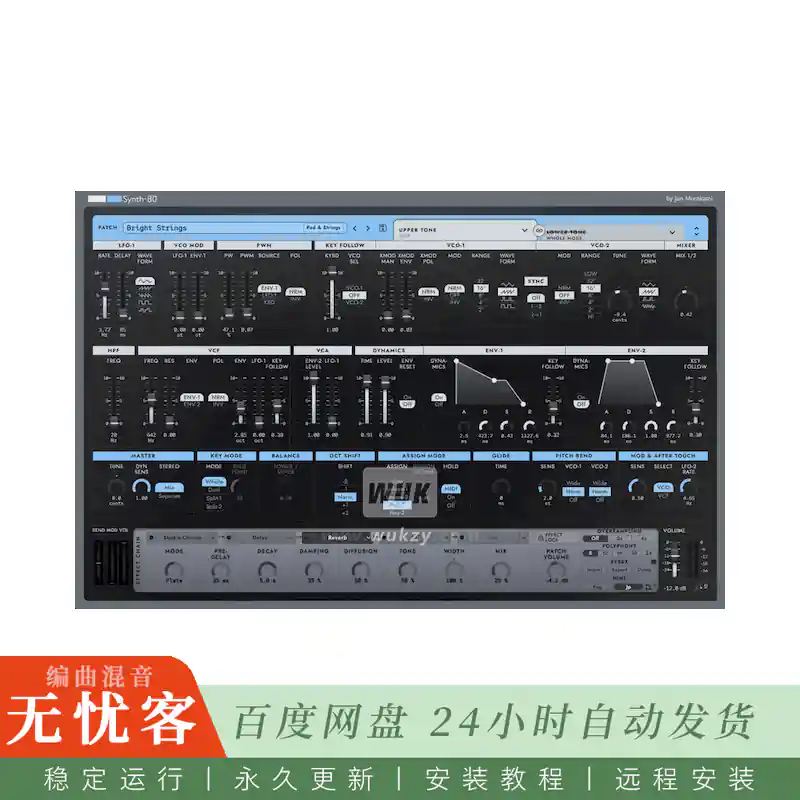
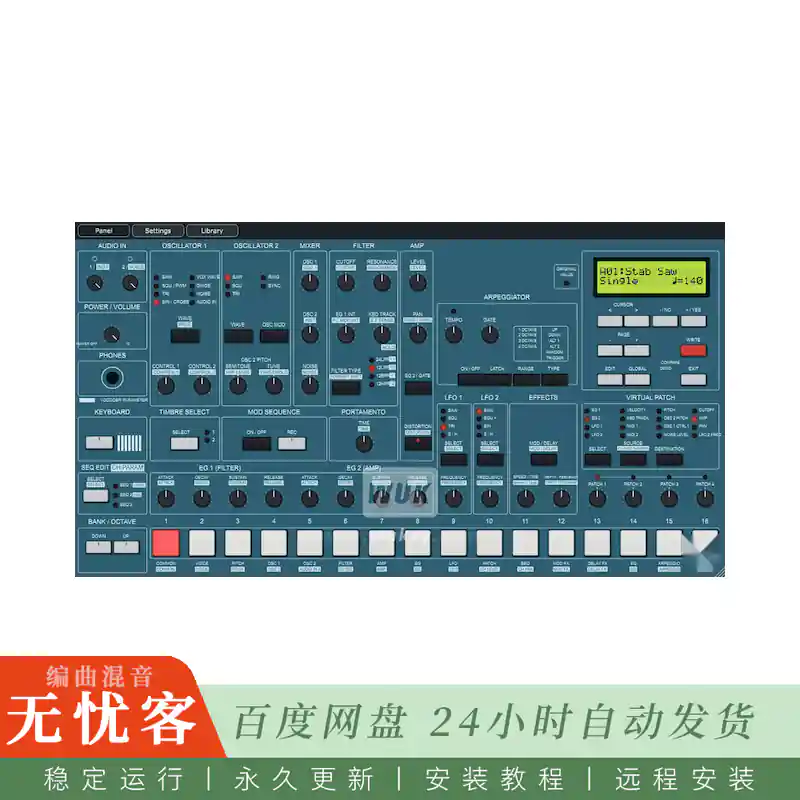
该合成器的开发与通用软件合成器的概念不同,该合成器具有广泛的调制矩阵。不仅仅是复制硬件,它唯一最重要的目标是让您感受到声音设计的轻松和愉悦程度-在简单的用户界面中实现的目标,该界面可消除所有不必要的参数和装饰并显示所有参数在一个屏幕上。
这种哲学受到了我的粉丝Daichi的Synth1的影响,并且简单的命名遵循Synth1的领导。作为只有软件才能提供给初学者的功能,将鼠标悬停在参数上突出显示相关模块,因此信号接线-哪个模块连接到哪里-一目了然。
高品质音效,包括四个独立的合唱效果
内置的效果制作到一个水平,你会想自己使用它们-事实上,synth-80效果架可以拆分出来,并作为一个独立的音频效果插件。合唱,在合成声音设计中特别重要,有四种完全不同的型号:
合成器合唱
受罗兰·朱诺-60/106等合成器内置合唱影响的仿真,具有强烈的个性-包括音符放在一起时的旋转状声音。
工作室合唱团
模仿传奇的机架安装合唱团Roland Dimension D。其低warble算法融入任何声音,给人一种自然而精致的宽度感。
音高合唱
受Eventide单位启发的合唱,通过将延迟线失谐到两个略有不同的音高来创建宽度。
数字合唱
具有最多参数的合唱,让您对各种元素进行精细控制,以精确地拨入所需的纹理。
除此之外,具有完全不同的大厅,盘子和房间算法的混响,以及采用ZeroComp算法的压缩机,为您的声音设计提供强大的支持。
不是轻量级的合成器-而是重量级的声音
由于其复杂的建模到最精细的细节,这个合成器是-以换取它的声音-在CPU上绝不发光。请不要仅通过此页面上的浏览器版本来判断它; 一定要将演示安装到您自己的DAW中并在那里尝试。作为回报,我们承诺一个值得付出代价的声音。
简介:
Jun Murakami Synth-80 v1.0.23 Incl Patched and Keygen-R2R
Team R2R | 05 Oct 2026 | 11.0MB
The world’s only, and finest, JUPITER that faithfully recreates the legendary MKS-80.
The Roland MKS-80 SUPER JUPITER is a legendary synthesizer produced only for a short period beginning in 1984. Often overshadowed by popular keyboards such as the JUPITER-8, this 8-voice polyphonic analog synthesizer is defined not only by its refined sound but also by a remarkable trait: almost every one of its parameters can be controlled over MIDI.
For a fully analog synthesizer of its era this was extraordinarily rare, and it makes the MKS-80 an ideal subject for software-synthesizer research — in other words, it is easy to build measurement programs that retrigger notes again and again while automatically sweeping the parameters, capturing detailed analyses. For this project I wrote more than 100 dedicated automated measurement programs covering every circuit and parameter of the MKS-80.
This long-term, detailed analysis of the MKS-80 (Rev.4) was carried out in parallel with the software programming itself, and I pushed the audio DSP tuning to the very limit, relying on the ears I have cultivated over many years as a composer and music producer. As a result, when you load exactly the same patch on both and play them side by side, for many patches it is virtually impossible to tell which is the software and which is the hardware.
From the delicate characteristics of the filters to the noise oscillators with subtle nuances derived from IC chips, the sound texture, recreated with meticulous attention to every detail, elevates the level of hardware emulation to a new height.
A simple, stripped-down user interface
This synthesizer was developed with a different concept from the all-purpose software synths packed with extensive modulation matrices. Beyond merely reproducing the hardware, its single most important goal is to let you feel how easy and how enjoyable sound design can be — a goal realized in a simple user interface that strips away every unnecessary parameter and ornament and shows all parameters on a single screen.
This philosophy is influenced by Synth1 by Daichi, of whom I am a fan, and the straightforward naming follows Synth1’s lead. As a feature only software can offer to beginners, hovering the mouse over a parameter highlights the related module, so the signal wiring — which module connects to where — is clear at a glance.
High-quality effects, including four independent choruses
The built-in effects are crafted to a level where you would want to use them on their own — in fact, the Synth-80 effect rack can be split out and used as a standalone audio effect plugin. The chorus, especially important in synth sound design, comes in four completely different models:
Synth Chorus
An emulation influenced by the built-in choruses of synths such as the Roland JUNO-60/106, with a strong character all its own — including a rotary-like sound when notes are held together.
Studio Chorus
An emulation of the legendary rack-mount chorus, the Roland Dimension D. Its low-warble algorithm blends into any sound, giving a natural and refined sense of width.
Pitch Chorus
A chorus inspired by Eventide units, creating width with delay lines detuned to two slightly different pitches.
Digital Chorus
The chorus with the most parameters, giving you fine control over a wide range of elements to dial in exactly the texture you want.
Beyond these, a reverb with completely different Hall, Plate, and Room algorithms, and a compressor that adopts the ZeroComp algorithm as-is, give your sound design powerful support.
Not a lightweight synth — but a heavyweight sound
Because of its complex modeling down to the finest details, this synth is — in exchange for its sound — by no means light on the CPU. Please do not judge it by the browser version on this page alone; be sure to install the demo into your own DAW and try it there. In return, we promise a sound worthy of that cost.

评论0