
简介:
推送和凹槽Filteronix v1.2.0 1.2.1 AU,VST3 WiN MAC [免费]
免费 | WiN MAC | 5 MB
模拟字符,而不会失去控制。
FILTRONIX将电路启发滤波与现代DSP技术相结合,可实现平滑谐振,可控驱动和实用的混合就绪操作。
电路建模
行为建模
滤波器拓扑、反馈、饱和和共振作为一个系统而不是一堆不相关的效应相互作用。
ZDF / TPT
保持共振响应
零延迟反馈拓扑支持平滑的截止运动和高共振时的稳定行为。
非线性驱动
清晰地添加音调
ADAA饱和度和4x过采样有助于控制混叠,而驱动级会增加权重和边缘。
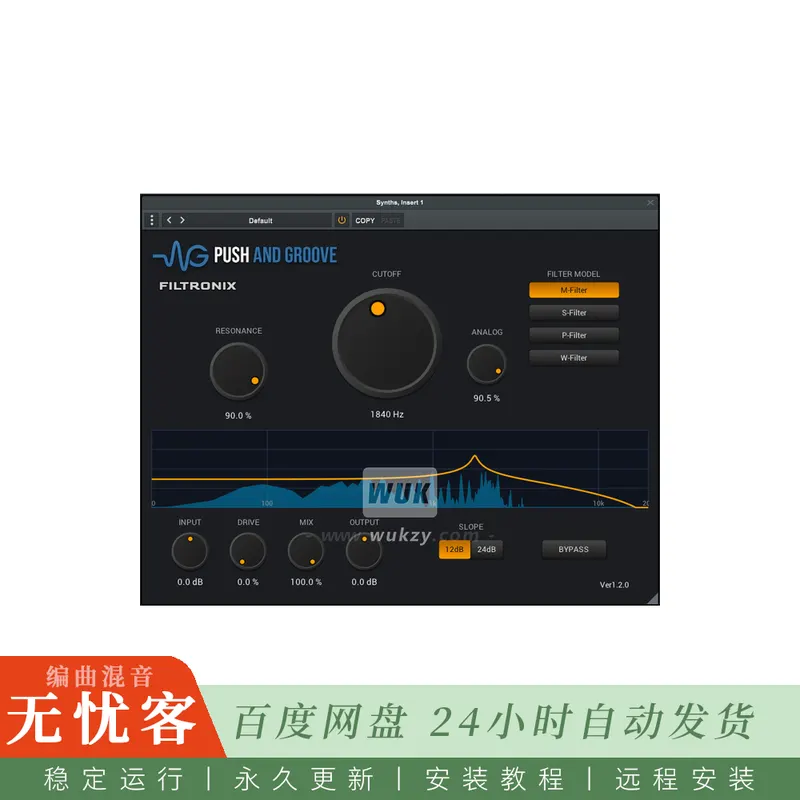
视觉反馈
看到滤镜移动了
频谱和响应显示使截止,共振和色调变化易于遵循。
四个电路。四个性
在不重建处理链的情况下切换过滤器字符。
M-过滤器
阶梯晶体管
一个明显的共振峰,带有经典梯子响应的熟悉的音乐低端运动。
S-滤镜
经典状态变量
一个厚的,集中的响应,使重量保持在强烈的共振和接近自激振荡。
P滤波器
复音OTA
受经典复调乐器声音启发的胖而有力的级联角色。
W-过滤器
英国CMOS
具有突然共振和明显原始电路特征的不稳定,激进的响应。
为什么ZDF/TPT很重要。
当截止和共振被推动时,反馈回路是模拟滤波器如何响应的核心。
延迟反馈
一种数字妥协
反馈路径内的单位延迟可以改变响应并且使极端共振感觉较少连接。
零延迟反馈
更紧密的电路响应
ZDF/TPT解决了当前样本内的反馈关系,以实现更平滑的控制和更类似模拟的交互。
FILTRONIX将ZDF/TPT滤波与非线性饱和,4x过采样和相位补偿的33抽头FIR多相级相结合。
模拟运动,而不是静态完美。
模拟控制引入细微的变化,使过滤器感觉不太机械相同的时刻。
格式
Windows VST3 / macOS AU和VST3
简介:
Push and Groove Filteronix v1.2.0 1.2.1 AU, VST3 WiN MAC [FREE]
FREE | WiN MAC | 5 MB
Analog character without losing control.
FILTRONIX combines circuit-inspired filtering with modern DSP techniques for smooth resonance, controllable drive, and practical mix-ready operation.
Circuit modeling
Model the behavior
Filter topology, feedback, saturation, and resonance interact as one system instead of a stack of unrelated effects.
ZDF / TPT
Keep resonance responsive
Zero-delay feedback topology supports smooth cutoff movement and stable behavior at high resonance.
Nonlinear drive
Add tone with clarity
ADAA saturation and 4x oversampling help control aliasing while the Drive stage adds weight and edge.
Visual feedback
See the filter move
The spectrum and response display make cutoff, resonance, and tonal changes easy to follow.
Four circuits. Four personalities.
Switch filter character without rebuilding your processing chain.
M-Filter
Transistor ladder
A pronounced resonant peak with the familiar musical low-end movement of a classic ladder response.
S-Filter
Classic state variable
A thick, focused response that keeps weight around strong resonance and near self-oscillation.
P-Filter
Polyphonic OTA
A fat and punchy cascade character inspired by the sound of classic polyphonic instruments.
W-Filter
British CMOS
An unstable, aggressive response with sudden resonance and a distinctly raw circuit character.
Why ZDF / TPT matters.
The feedback loop is central to how an analog filter responds when cutoff and resonance are pushed.
Delayed feedback
A digital compromise
A unit delay inside the feedback path can change the response and make extreme resonance feel less connected.
Zero-delay feedback
A tighter circuit response
ZDF / TPT solves the feedback relationship within the current sample for smoother control and more analog-like interaction.
FILTRONIX combines ZDF / TPT filtering with nonlinear saturation, 4x oversampling, and a phase-compensated 33-tap FIR polyphase stage.
Analog movement, not static perfection.
The Analog control introduces subtle variation that makes the filter feel less mechanically identical from moment to moment.
Formats
Windows VST3 / macOS AU & VST3


评论0