
【译文】
简介:
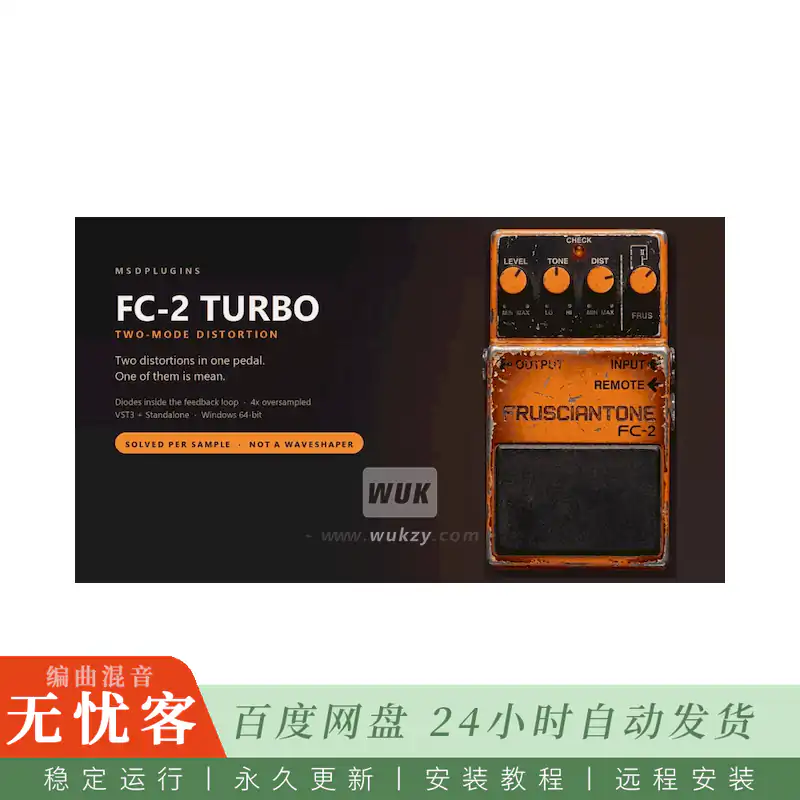
MSDplugins FC-2 TURBO v1.0.1独立VST3 WiN [免费]
免费 | WiN | 8.34 MB
Boss DS-2风格失真。
从工厂原理图建模的双模失真,其中限幅二极管位于运算放大器的反馈环路内-因此它们会降低环路增益,而不是剪切波形的顶部。每个样本都作为电路求解,而不是用波形成形器曲线伪造。
大多数失真插件剪辑信号。这降低了环路增益。
在这个电路中,削波二极管不会坐在输出上,剪切波形的顶部-它们是有线的
在运算放大器的反馈路径内
。随着信号的增长,二极管开始导通,放大器自身的增益在其下方下降。结果压缩和绽放,而不是平方,它会对你的拾取手做出反应,因为你击中它的力度会改变电路的增益。
这种行为不能用静态曲线伪造,所以它不是。FC-2 Turbo在每个样本中求解一次限幅器的电路方程,反馈电容器和电源轨都在求解中,在4倍过采样。
两种模式,它们是两个不同的踏板
模式I是直音-中前音,仍然可以识别出您的吉他,在已经工作的放大器前很高兴。
模式II是turbo语音,它是
具有更多增益的非模式I
。不同的网络馈送到削波器,并且不同的过滤器跟随它。在运输建造上测量,模式II携带
12.9 dB更多1 kHz-against-5 kHz倾斜
-这是鼻,人声,切割质量,这就是为什么模式II在一个繁忙的混音中处于一个模式I会消失的水平。
它生活的地方
–
九十年代的另类和垃圾节奏
,这种踏板是声音,而不是对其他东西的推动。
–
朋克和流行朋克
-模式II的中音正是在一堵钹墙中幸存下来的切口。
–
斯托纳和沙漠岩石
,模式I转换为已经驱动的放大器。
–
噪音摇滚和后铁杆
,模式II在高DIST,重点是它变得真正令人不快。
–
任何必须坐在密集混合物中的东西
不需要它的中端EQ就可以了。
它不仅仅是一个吉他工具。它在低音上,在您想要丑陋的鼓巴士上以及在synth leads上具有牙齿。
四个控件和预设,远离你的方式
DIST,音调,水平,模式。从顶部栏中按名称保存声音; 预设会存储这四件事,只有这四件事-加载一个永远不会关闭踏板或调整窗口大小。预设文件是磁盘上的纯XML,因此您可以在计算机之间复制它们。
使它与众不同的不是旋钮-而是被测量的
它是根据原理图建模的,而不是根据印象建模的。
每个块的传递函数都是从电路中手动导出的,然后针对编译的插件进行检查。在过采样区域中,模型将这些导数跟踪到0.013 dB。
每个版本都必须通过线束。
在编译的插件上测量的41个行为检查,加上31个自检,其唯一的工作是证明测量代码实际上可以报告故障。
过采样因子是测量的,而不是假设的。
4x,因为在故意讨厌的测试音调上,它使混叠降低了28.8 dB,而8x在那里又购买了9 dB,而在实际的吉他音符上根本没有购买任何东西-地板已经降低了70 dB。
旁路是诚实的。
脚踏开关也是主机的旁路参数,所以面板和你的DAW永远不会不同意,当你踩踏它时,报告的延迟不会改变 — 你的轨道永远不会在你中间移动。
引擎盖下-在运输建筑上测量
-线性链与手工导出的传递函数:
0.013 dB
(过采样区域)
-模式II额外1 khz/5 khz倾斜:
12.93 dB
实测vs 13.17 dB预测值
-跨分区0 → 10的THD:
− 16.7 → − 11.2 dB
,单调
-混叠,酷刑音,4倍:
28.8 dB
向下
-混叠,打开G,4x:
70.4 dB
向下
-直流输出,热,两种模式:
低于0.001
-立体声通道:
位-相同
-绕过的延迟:
未改变
未声明的内容:
没有物理单元是A/B ‘d对这个插件-这里没有硬件来比较。它是从原理图中表达出来的,并根据自身进行测量,上面的每个数字都来自您正在下载的构建。
功能
–
DIST / TONE / LEVEL / MODE
,没有什么你必须学习。
–
两个独立的语音
,而不是增益开关。
-反馈回路中的二极管削波器,
每个样本已解决
在4x过采样。
–
命名预设
在磁盘上,纯XML,仅发声。
–
可点击脚踏开关旁路
,也是主机旁路参数,延迟匹配。
-窗口大小
50% / 75% / 100%
。
-逼真的踏板界面。
【原文】
简介:
MSDplugins FC-2 TURBO v1.0.1 STANDALONE VST3 WiN [FREE]
FREE | WiN | 8.34 MB
Boss DS-2 style Distortion.
A two-mode distortion modelled from a factory schematic, where the clipping diodes sit INSIDE the op-amp’s feedback loop – so they drop the loop gain instead of shearing the tops off your waveform. Solved as a circuit every single sample, not faked with a waveshaper curve.
Most distortion plugins clip the signal. This one drops the loop gain.
In this circuit the clipping diodes are not sitting across the output shearing the tops off your waveform — they are wired
inside the op-amp’s feedback path
. As the signal grows, the diodes start conducting and the amplifier’s own gain falls away underneath it. The result compresses and blooms instead of squaring off, and it reacts to your picking hand, because how hard you hit it changes how much gain the circuit has.
That behaviour cannot be faked with a static curve, so it isn’t. FC-2 Turbo solves the clipper’s circuit equation once per sample, with the feedback capacitor and the supply rail both inside the solve, at 4x oversampling.
Two modes, and they are two different pedals
Mode I is the straight voice — mid-forward, still recognisably your guitar, happy in front of an amp that is already working.
Mode II is the turbo voice, and it is
not mode I with more gain
. A different network feeds the clipper and a different filter follows it. Measured on the shipping build, mode II carries
12.9 dB more 1 kHz-against-5 kHz tilt
— that is the nasal, vocal, cutting quality, and it is why mode II sits forward in a busy mix at a level where mode I would vanish into it.
Where it lives
–
Nineties alternative and grunge rhythm
, where this kind of pedal was the sound rather than a boost into something else.
–
Punk and pop-punk
— mode II’s midrange is exactly the cut that survives a wall of cymbals.
–
Stoner and desert rock
, mode I into an already-driven amp.
–
Noise rock and post-hardcore
, mode II at high DIST, where the point is that it gets genuinely unpleasant.
–
Anything that has to sit in a dense mix
without needing its midrange EQ’d back in afterwards.
It is not only a guitar tool. It has teeth on bass, on a drum bus you want ugly, and on synth leads.
Four controls, and presets that stay out of your way
DIST, TONE, LEVEL, MODE. Save a sound by name from the top bar; a preset stores those four things and only those four — loading one will never switch the pedal off or resize your window. Preset files are plain XML on disk, so you can copy them between machines.
What makes it different isn’t the knobs — it’s what was measured
It is modelled from the schematic, not from an impression.
Every block’s transfer function was derived by hand from the circuit and then checked against the compiled plugin. In the oversampled region the model tracks those derivations to 0.013 dB.
Every release has to pass the harness.
41 behavioural checks measured on the compiled plugin, plus 31 self-tests whose only job is to prove the measurement code can actually report a failure.
The oversampling factor was measured, not assumed.
4x, because on a deliberately nasty test tone it puts aliasing 28.8 dB down, and 8x buys another 9 dB there while buying nothing at all on an actual guitar note — where the floor is already 70 dB down.
Bypass is honest.
The footswitch is also the host’s bypass parameter, so the panel and your DAW can never disagree, and the reported latency does not change when you stomp it — your track never shifts under you mid-take.
Under the hood — measured on the shipping build
– Linear chain vs hand-derived transfer functions:
0.013 dB
(oversampled region)
– Mode II extra 1 kHz / 5 kHz tilt:
12.93 dB
measured vs 13.17 dB predicted
– THD across DIST 0 → 10:
−16.7 → −11.2 dB
, monotonic
– Aliasing, torture tone, 4x:
28.8 dB
down
– Aliasing, open G, 4x:
70.4 dB
down
– DC on the output, hot, both modes:
below 0.001
– Stereo channels:
bit-identical
– Bypassed latency:
unchanged
What is not claimed:
no physical unit was A/B’d against this plugin — there is no hardware here to compare with. It is voiced from the schematic and measured against itself, and every number above comes from the build you are downloading.
Features
–
DIST / TONE / LEVEL / MODE
, and nothing you have to learn.
–
Two separate voicings
, not a gain switch.
– Diodes-in-the-feedback-loop clipper,
solved per sample
at 4x oversampling.
–
Named presets
on disk, plain XML, voicing-only.
–
Clickable footswitch bypass
, also the host bypass parameter, latency-matched.
– Window sizes
50% / 75% / 100%
.
– Photoreal pedal interface.




评论0